

Church Rock in Utah is a 200‑foot Entrada Sandstone monolith standing alone in the wide desert valley between Monticello and Moab, right off U.S. Route 191. It’s one of those formations that feels almost placed—a solitary dome rising from an otherwise open plain, with the La Sal Mountains often snow‑tipped behind it.
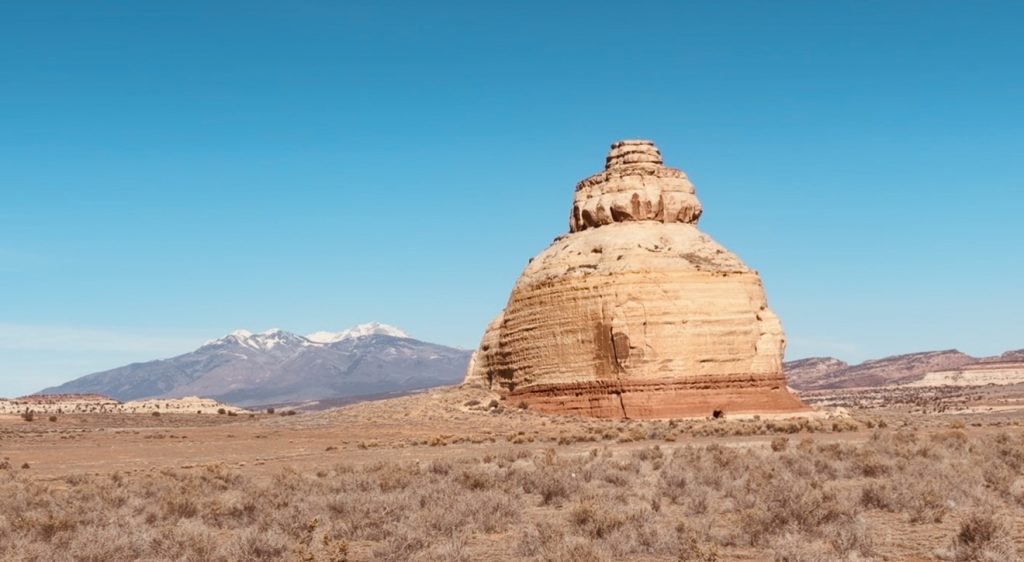
One of the interesting pages of 1930s myths tells about Church Rock, and how the gumdrop shaped rock earned its name. The story is of how Marie Ogden’s Home of the Truth, a Utopian community, was erroneously responsible. Ogden was a spiritualist during the 1920s, giving lectures across the U.S. on spiritualism, until she came to San Juan County, Utah. She allegedly called San Juan County and Church Rock “the spiritual center of the universe.” With a small band of followers, Ogden’s group moved onto a tract of barren land along Utah’s Route 211 in 1933, calling it the “Home of Truth.” Members turned all their worldly goods to Ogden to join her Home of Truth, abiding by a strict code of conduct, were expected to work for the common goals of the settlement.
Part of the myth is that the group set upon a grand plan to hollow out the entire center of the sandstone monument, by hand, to build a church. In fact, the sandstone formation was owned by a local rancher, Claud Young of Monticello. Young owned about 2000 acres of land, for cattle range, before the highway came through the area known as Dry Valley.
The only evidence of the myth, and the apparent basis for the assumption of turning the rock into a ‘church,’ is the 16 by 24 foot opening chiseled into the rock. In fact, that ‘opening’ was contracted out by the owner, Claud Young. The opening was done through the use of dynamite and cut out of the stone during the late 1940s to store salt licks and feed for the cattle. The rock is still owned by the Young family, in equal shares by the two daughters and two sons of Claud and Inez Young, their surviving spouses, and/or surviving grandchildren owning their percentage of the rock.
Source: Wikipedia
Happy Exploring Utah!